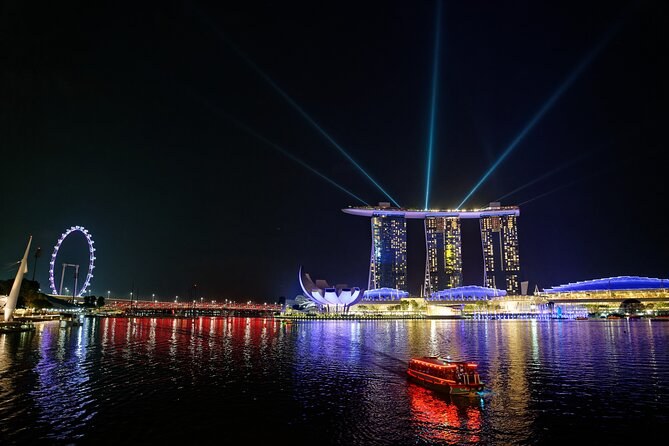
Private Singapore Night City Tour with Driver
Airport pickupPrivate4 to 5h
The evening answer in any month: both free light shows timed in, and the coolest hours of the day.
From $87 per person
Singapore sits a degree north of the equator. The mean daily maximum runs between 30.5 °C in December and 32.4 in April, and the mean daily minimum never drops below 24.3. That is a spread of under two degrees across a whole year.
What does move is the rain: 2,113 mm across 171 days, distributed very unevenly. So the seasonal question on a layover is not "will I be warm" — you will — but "will I be walking in a downpour", and the answer changes a lot between February and December.
| Season | Months | The pattern | What it means for a window |
|---|---|---|---|
| Northeast monsoon | December to early March | Long grey spells rather than short bursts | A driving window loses least; walking loses most |
| Inter-monsoon | Late March to May | The hottest months, with afternoon thunderstorms | Morning windows are the reliable ones |
| Southwest monsoon | June to September | Sumatra squalls between the predawn hours and midday | The pattern inverts: afternoons are often clearer |
| Inter-monsoon | October to November | Storms build again, at times severe | November's nineteen rain days are the warning |
The inversion in June to September is the least-known part of this and the most useful. In most of the year the afternoon carries the storm risk; in the southwest monsoon it is the morning.
February and September, on the figures. February is the driest month of the year at 105.1 mm across nine rain days, and its daytime high sits a degree below the April peak. September is the second-driest at 124.9 mm across thirteen.
Neither is a season in the way a temperate country has seasons. They are simply the two months where the odds of walking in dry weather are best, which on a window measured in hours is the only variable you can plan around.
November and December, without much argument. Nineteen rain days each, and December brings 331.9 mm — more than three times February's total. The northeast monsoon brings long spells rather than the short heavy bursts of the inter-monsoon, so waiting one out is less reliable.
If your connection falls in either month and you have six hours, take a car rather than a walking product. A driver reorders the route around the conservatories, the temples and the malls; a walking host gets wet with you. The walking tour page is honest about the difference.
Regional haze can arrive in some years around August and September and is absent in others, which makes it the one seasonal factor you cannot plan for. What it affects first is visibility from the SkyPark observation deck and the quality of any long view.
The practical response is to check conditions on the day rather than to avoid the months. If the view is the point of your window and the air is poor, swap the deck for the conservatories, which are indoors and unaffected.
The Formula 1 Singapore Grand Prix runs on the Marina Bay Street Circuit, and the 2026 race is on 9 to 11 October. Two of the driving operators state on their own listings that parts of Marina Bay and City Hall may close during it, that routes change and that alternatives are offered.
That is not a reason to avoid the weekend. It is a reason to expect a different route, and to build an extra half hour into the return leg. The city is also at its busiest, so book earlier than you otherwise would.
Very little, which is one of the easier things about this city. An umbrella and a litre of water each cover every month of the year, and one walking operator asks for exactly that in its own listing.
What changes is how likely you are to need the umbrella. In February you have nine rain days in twenty-eight; in November and December, nineteen in thirty. The umbrella weighs the same either way, so carry it and stop thinking about it.
The other constant is shoes. Covered shoulders and knees for the temples, and something you can walk several kilometres in, because the shophouse districts are cobbled in places and the five-foot-ways step up and down between buildings.
Three periods put pressure on the products rather than on the city: the Grand Prix weekend in October, the year-end holidays through late December, and Chinese New Year, whose date moves. In all three the private guides fill first, because there are fewer of them than there are cars.
What it means in practice is booking earlier rather than paying more. Fares here are set by the operators and do not visibly swing by season, but availability does. Three or four days ahead is comfortable in an ordinary week; a fortnight is sensible around a major event.
Crowds at the free things move differently. Garden Rhapsody and Spectra are busiest at weekends and on public holiday eves, which is also when Spectra runs its extra 22:00 show. If you want the show without the crush, take the earlier of the two.
Morning, in most of the year. Humidity peaks before sunrise and the heat has not built, so an 08:00 start on foot is a different experience from a 14:00 one. The exception runs from June to September, when the squalls come early and the afternoon is often the clearer half of the day.
Evening is the other good answer, and it works in every month. The temperature drops a couple of degrees, the two free light shows run at 19:45, 20:00, 20:45 and 21:00, and the skyline is the thing most people came to photograph.
They change the crowds rather than the conditions, and on a layover the crowds only matter in three places: the conservatories at Gardens by the Bay, the observation deck, and Sentosa. Everything else on a short window is open ground.
The dates worth knowing are the mid-year break through June, the year-end break from mid-November, and Chinese New Year, whose date moves between late January and mid-February. Public holiday eves also matter for one small reason: Spectra runs an extra 22:00 show on those nights, and so does the light showcase at Jewel.
Almost nothing here is seasonal. The outdoor gardens run 05:00 to 02:00 all year. The conservatories run 09:00 to 21:00 all year. The temples, the districts and the hawker centres keep their own hours regardless of month.
What does change is daylight, and barely: this close to the equator, sunset moves by under half an hour across the whole year. An evening plan made in June works in December, which is not true anywhere further north.
The month-by-month page carries the figures for each one, and a Singapore layover tour from airport can be booked for whichever shape of day the month suggests.
Yes, though not by much and not for the reason people expect. Fares here are the operators' own and do not visibly swing with the calendar. Availability does.
Three or four days ahead is comfortable in an ordinary week. Around the Grand Prix weekend, the year-end holidays and Chinese New Year, give it a fortnight, because the private guides are the first thing to go and there are fewer of them than there are cars.
Booking early costs nothing either way. Every product listed here refunds in full up to 24 hours before the start time, so an early booking on a connection that later changes is a cancellation rather than a loss. The FAQs cover how each operator handles a moved inbound.
The evening answer in any month: both free light shows timed in, and the coolest hours of the day.
From $87 per person
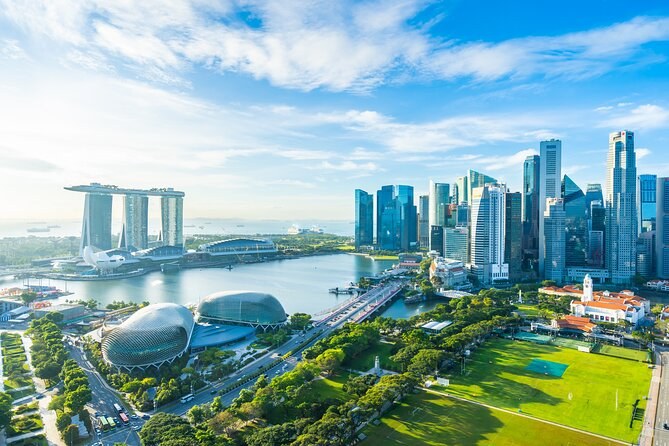
The wet-season answer, with air conditioning between every stop and a route that reorders itself around a storm.
From $80 per person
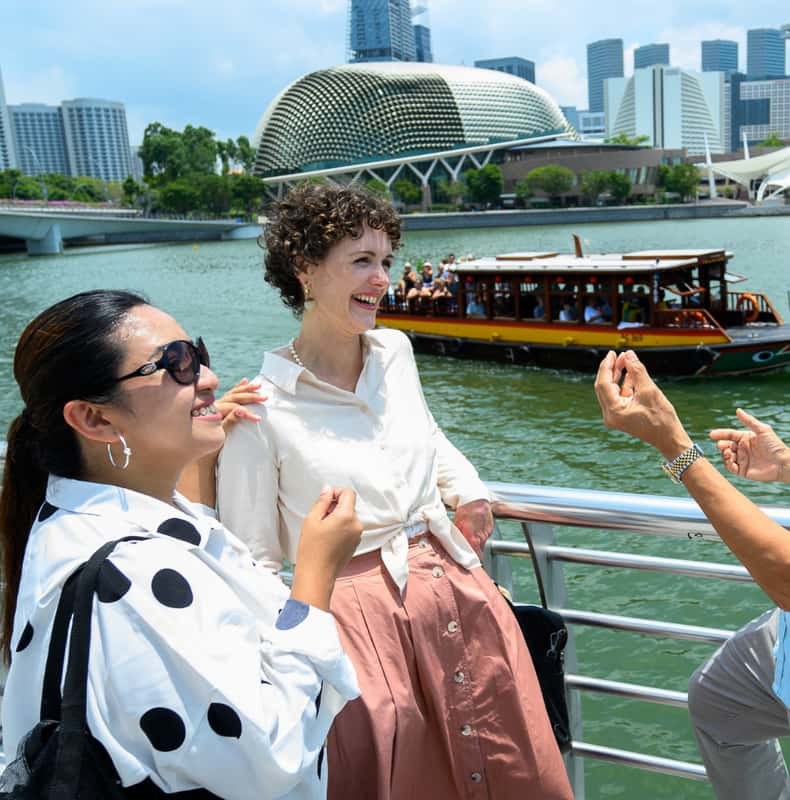
The February and September answer, on foot with a licensed local host and a route built around you.
From $83 per person
The figures behind all of this are on the month-by-month weather page, and every window is on Singapore Layover Tours.